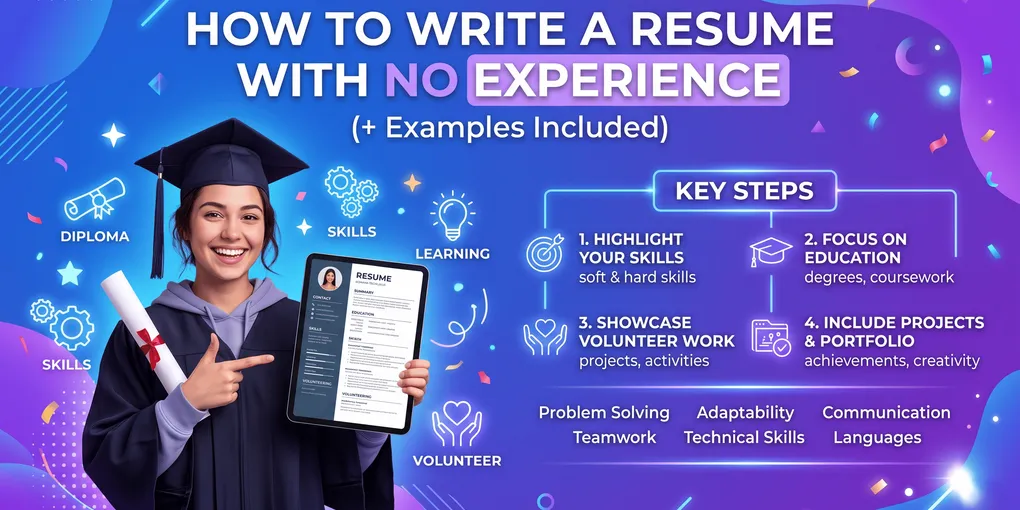
How to Write a Resume With No Experience (+ Examples)
A hiring manager looking at an entry-level resume isn’t asking “where has this person worked?” They’re asking one quieter question: “Will this person figure things out and get them done?” That’s good news, because it means a blank Work Experience section doesn’t disqualify you — it just means you have to prove that single thing a different way. And you already have more proof than the cursor blinking on that empty page is telling you.
This guide shows you exactly how to write a resume with no experience: what actually counts as experience, the format that won’t make the page look empty, and a repeatable formula for turning coursework, projects, and volunteering into bullets that sound like achievements. For the full structural walkthrough, pair this with our step-by-step guide to writing a resume from scratch — this article is the no-experience companion to it.
TL;DR — how to write a first resume:
- Lead with your education and a short summary, not an empty Work Experience header.
- Replace “Work Experience” with Projects, Volunteer Experience, and Activities sections.
- Use a combination (hybrid) format — not a pure functional one, which fails applicant tracking systems.
- Write achievement bullets, not duties (action verb + what you did + result).
- Keep it to one page, and tailor it to each posting. Ready to build it? Create your first resume free.
First, What Actually Counts as “Experience”?
The blank page lies to you. It implies “experience” means “a paid job with a manager and a name badge.” Recruiters define it far more broadly: experience is any situation where you took initiative, solved a problem, or worked with other people toward a result. That’s why employers reviewing student resumes care less about job titles than about evidence — and they say so directly. In NACE’s Job Outlook 2025 survey, nearly 90% of employers said they look for evidence of problem-solving ability on a candidate’s resume, and nearly 80% look for teamwork. Neither of those requires a past employer.
So the worst thing you can do is treat the page as empty:
❌ Work Experience: None. (Or leaving the section blank, which signals you gave up.)
✅ Instead, mine the last three years for proof. Legitimate sources of experience include:
- Coursework and capstone projects (“Built a 12-page market analysis for a live local business”)
- Personal or class projects (an app, a website, a research paper, a budgeting spreadsheet)
- Volunteering (food bank, animal shelter, tutoring, event setup)
- Clubs, student government, and leadership (treasurer, team captain, event organizer)
- Sports and the arts (commitment, practice, performing under pressure)
- Informal and gig work (babysitting, tutoring, lawn care, retail shifts, freelance tasks)
- Online certificates and hackathons (Google, Coursera, a weekend build sprint)
Every one of those is a place where you showed up, made decisions, and produced something. That is experience.
Action step: Open a blank doc and brain-dump everything you’ve done in the last three years — school, unpaid, casual, online. Don’t filter yet. You’ll shape it into bullets later.
Pick the Right Format (and Skip the Functional-Resume Trap)
The internet’s most common advice for people with no experience is also its most dangerous: “use a functional resume so you can hide your lack of work history.” A pure functional resume groups everything under skill headings and drops dates entirely. Two problems. First, recruiters know exactly what it’s hiding the moment they see it — it reads as defensive. Second, it confuses the applicant tracking system (ATS) software that parses resumes, because those systems are built to read dated, clearly-labeled sections.
❌ A skills-only layout with no dates and no clear sections — “Communication,” “Leadership,” “Teamwork,” each followed by a vague paragraph.
✅ A combination (hybrid) format: a short skills-rich summary at the top, your education near the top, then dated Projects, Volunteer, and Activities sections below. It shows your strengths and keeps the honest, scannable structure recruiters and software expect. For a deeper comparison of when each layout works, see our breakdown of chronological, functional, and hybrid resume formats — the verdict for first-timers is the same: go hybrid.
Here’s where each section lives on a no-experience resume:
| Section | Include? | Order | Why |
|---|---|---|---|
| Contact info | Always | 1 | Name, professional email, phone, city, LinkedIn |
| Summary | Yes | 2 | Replaces a job title as your opening pitch |
| Education | Yes — lead with it | 3 | Your strongest, most recent credential |
| Relevant coursework | If related to the job | 4 (under Education) | Shows applied knowledge |
| Projects | Yes | 5 | Your best proof of skill in action |
| Volunteer experience | If you have it | 6 | Demonstrates initiative and reliability |
| Activities / leadership | If you have it | 7 | Shows responsibility and teamwork |
| Skills | Yes | 8 | Keyword match for ATS and recruiters |
| Work Experience | Only if any exists | Optional | Even one retail shift counts — don’t force a blank header |
Action step: Choose a single-column hybrid layout and move Education to the top. Delete any empty “Work Experience” heading.
Write a Summary That Sells Potential
With no job title to lead with, your summary does the heavy lifting. It’s the first thing read and the easiest thing to get wrong, because the instinct is to describe your situation instead of your value.
❌ “Recent graduate seeking an opportunity to grow and gain experience in a dynamic company.” (This is about what you want, and it could belong to anyone.)
✅ “Detail-oriented marketing graduate with hands-on project experience running a 4-week social campaign that grew a student club’s following by 60%. Seeking a junior marketing role where I can apply analytics and content skills.”
The difference is proof. Use this formula: [adjective] + [field/degree] + [proof point] + [target role/goal]. Notice the good version names a specific result (60% growth) and a specific target role. That’s what makes a recruiter keep reading instead of mentally filing you under “generic.”
If you want a structure you can fill in line by line, our resume summary examples and 3-sentence formula includes entry-level versions you can adapt directly.
Action step: Write your summary last, after your projects section exists — it’s far easier to summarize achievements you’ve already written down than to invent them from scratch.
Turn Projects, Volunteering & Activities Into Achievement Bullets
This is the section that separates a first resume that gets interviews from one that gets ignored. Most people list duties — what they were responsible for. Recruiters want achievements — what changed because you were there. The fix is one formula: action verb + what you did + result (with a number where possible).
Watch a “trivial” line transform. Here’s a real before/after rewrite of the kind of entry everyone undervalues:
❌ Before: “Babysat for neighborhood families.”
✅ After: “Supervised 3 children (ages 4–9) for 15+ hours per week; managed schedules, meals, and conflict resolution, earning repeat bookings from 5 families.”
Same activity. The second version proves responsibility, time management, and a track record of trust — exactly the soft proof an employer is hunting for. Apply the same lens to a project and a club role:
❌ “Worked on a group marketing project.” → ✅ “Led a 4-person team to build a marketing plan for a local café; our proposed loyalty program was adopted and increased the owner’s repeat visits in a 1-month pilot.”
❌ “Member of the debate club.” → ✅ “Competed in 8 regional debate tournaments; placed top 3 twice and mentored 2 first-year members in argument structure.”
Each fix starts with a strong verb (supervised, led, competed), names what you actually did, and lands on a result. Want to see how full sections look assembled? Browse our entry-level resume examples for inspiration on layout and phrasing.
Action step: Rewrite every line from your brain-dump using action verb + what + result. If a line has no result yet, add a number — hours, people, frequency, or outcome.
Choose Skills Recruiters Can Actually Verify
The skills section is where first resumes go to die, because the temptation is to stuff it with unverifiable adjectives. A recruiter reads “hard worker” the same way they read white space — they skip it.
❌ “Team player, hard worker, fast learner, detail-oriented, motivated.”
✅ A focused mix of hard and soft skills that are backed up elsewhere on the page: “Python, Google Analytics, Canva, Spanish (conversational), event coordination, public speaking.” Each of those can be traced to a project, course, or activity you listed above — which makes them believable.
The trick is to balance both types. Hard skills (tools, languages, software) prove you can do the technical part; soft skills prove you can work with people. Our guide to hard skills vs soft skills explains how to pick the right ratio for your field. And don’t guess at which skills to feature — lift the exact terms from the job posting. The phrases the employer used are the phrases their screening software is scanning for, which is exactly what our walkthrough on finding and using resume keywords is built to help you do.
Action step: Paste the job posting next to your resume. Highlight every skill it names that you genuinely have, and make sure each one appears in your skills section and is backed by a bullet above.
Make It ATS-Safe (Yes, Even Your First Resume Gets Scanned)
It’s tempting to assume entry-level applications skip the robots. They don’t. Most mid-to-large employers route every application — junior roles included — through an applicant tracking system before a human sees it. A resume designed to impress a person but built to break a parser never reaches that person.
❌ A first resume crammed with graphics, two-column tables, icons, a photo, a “Curriculum Vitae” header, and that no-dates functional layout — all of which scramble in parsing.
✅ Standard section headings (Education, Projects, Skills), a single column, normal fonts, dates on everything, and 1–2 exact phrases mirrored from the job ad. Save and submit as a text-based PDF or .docx, never an image.
If you’ve never thought about this layer, read our explainer on what an ATS is and how to write a resume that passes it before you submit anything — the formatting choices that look impressive are often the ones that get silently filtered.
Action step: Re-read the job posting and copy 1–2 of its exact phrases (a tool, a certification, a skill) into your resume, word for word, where they’re true.
First-Resume Mistakes That Get You Screened Out
Most rejections at the entry level come from a short list of avoidable errors. Scan this list against your draft:
- Padding or lying. Inventing experience is the fastest way to lose an offer in the interview. Reframe what’s real instead of fabricating what isn’t.
- Listing every high-school activity forever. Keep what’s recent and relevant; a college sophomore doesn’t need their 9th-grade book club.
- Using an objective instead of a summary. “Seeking to gain experience” centers you, not the employer.
- An unprofessional email address. Use firstname.lastname@, not a nickname from middle school.
- Going over one page. With no work history, a second page reads as filler.
For a broader catalog beyond the entry-level traps, see our roundup of resume mistakes that get you rejected.
Before you hit submit — the pre-send checklist:
- One page, single column, text-based PDF or .docx
- Education at the top with relevant coursework
- A summary that names a target role + one proof point
- Every bullet uses action verb + what + result
- Skills match the job posting and are backed up above
- No empty “Work Experience” header
- Professional email, correct phone, working LinkedIn URL
- Proofread once for typos, once out loud for clarity
Action step: Run the checklist top to bottom before every single application — not just the first.
FAQ
Can you write a resume with no experience at all?
Yes. A resume is proof that you can do the work, not a list of past job titles. Lead with your education and a short summary, then build sections from projects, volunteering, clubs, and informal work like tutoring or babysitting. Frame each entry around what you accomplished.
What do you put on a resume if you’ve never had a job?
Contact details, a summary, education with relevant coursework, then Projects, Volunteer Experience, Activities, and Skills. Convert each item into an achievement bullet, and mirror keywords from the job posting so your resume matches what the employer is scanning for.
How long should a first resume be?
One page. With no work history there’s no reason to run longer, and recruiters expect entry-level resumes to be brief. Use the space to expand projects and activities into specific, quantified bullets rather than padding with filler.
What is the best resume format when you have no experience?
A combination (hybrid) format. It puts your skills and education up front while keeping dated, scannable sections, so it reads as honest and parses cleanly through applicant tracking systems. Avoid a pure functional layout with no dates — it looks evasive and often breaks ATS parsing.
Should I include high school on my resume?
Include it if you’re a current high school student, a recent graduate, or a first-year college student with nothing more recent. Once you’ve completed a semester or two of college or earned a degree, drop high school and let your latest education lead.
Is it okay to use a resume objective instead of a summary?
Use a summary. An objective states what you want; a summary states what you offer plus a target role, which is far more persuasive. A modern entry-level summary can fold your goal into one phrase while still leading with proof.
Your First Resume Is the Hardest One You’ll Ever Write
The first resume feels impossible only because you’re measuring it against jobs you haven’t had yet — when the real task is translating what you’ve already done into language an employer recognizes. Use the formula, fill the page with proof instead of apologies, and that blank cursor stops being intimidating.
When you’re ready to turn your brain-dump into a clean, ATS-safe page, you can build your first resume free in CV-Mate. And if you’re still staring at the very top of the page wondering what to write, start with our resume summary examples — it’s the easiest first sentence you’ll write all day.
Ready to build your resume?
You've got the knowledge. Now put it into action—create a professional resume in under 10 minutes with our builder.
No credit card required · Export as PDF · ATS-friendly templates