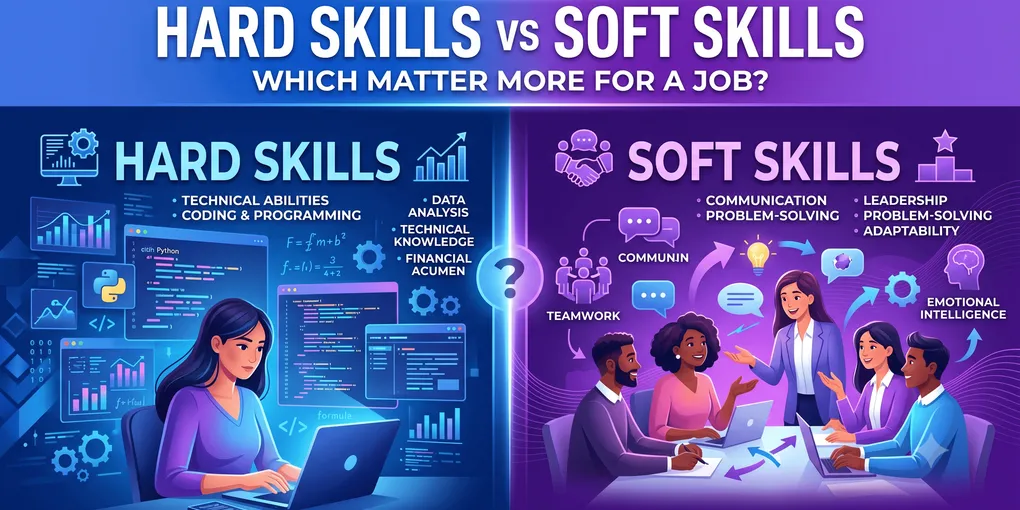
Hard Skills vs Soft Skills: Which Matter More for a Job?
“Should I focus on the technical stuff or the people stuff?” It’s one of the most common questions job seekers ask, and the honest answer is: you need both, but not in equal measure for every role. Understanding the difference between hard skills vs soft skills, and knowing which one carries more weight for the job you want, is what separates a resume that gets filtered out from one that gets a callback.
Hard skills get you shortlisted. Soft skills get you hired. Both decide whether you keep growing once you’re in the door. In this guide you’ll learn exactly what each type of skill is, which matters more depending on your role and seniority, what the hiring data actually says, and how to put both on your resume so recruiters and software take you seriously.
What Are Hard Skills?
Hard skills are specific, teachable abilities you can measure and prove. They’re usually tied to a tool, a discipline, or a certification, which makes them easy to test in an interview or verify with a portfolio.
Examples of hard skills include:
- Tech: Python, SQL, cloud architecture, Figma, data analysis
- Finance: financial modeling, forecasting, GAAP accounting
- Marketing: SEO, Google Ads, copywriting, email automation
- Trades and healthcare: welding, CNC machining, phlebotomy, EMR systems
- Languages: Spanish fluency, conversational Mandarin
The defining trait of a hard skill is that it has a clear answer to “can you do this, yes or no?” You either know how to build a financial model or you don’t. Because they’re concrete, hard skills are what applicant tracking systems and recruiters scan for first when they filter a pile of applications down to a shortlist.
Action step: Pull up a job posting you want and circle every hard skill it names. That list is your gatekeeper checklist, the exact terms that need to appear on your resume.
What Are Soft Skills?
Soft skills are the behavioral and interpersonal traits that shape how you work and how you work with others. They’re harder to measure, but they often determine who gets promoted and who gets left behind.
Common soft skills include communication, leadership, adaptability, problem-solving, time management, emotional intelligence, collaboration, and conflict resolution. Notice these aren’t tied to a single tool or industry, which is exactly why they transfer across every job you’ll ever hold.
Employers consistently rank these higher than candidates expect. In NACE’s annual Job Outlook survey, employers name problem-solving, teamwork, and a strong work ethic among the competencies they most want to see, often ahead of any specific technical tool. LinkedIn’s hiring research points the same direction: recruiters repeatedly flag communication and adaptability as the skills hardest to find and most predictive of long-term success.
The catch is that soft skills are easy to claim and hard to prove. Writing “excellent communicator” on a resume means nothing. Demonstrating it with a result means everything, and we’ll cover exactly how below.
Action step: For each soft skill you’d claim, write one sentence describing a moment you actually used it and what happened. If you can’t, drop the claim.
Hard Skills vs Soft Skills: Which Matter More?
Here’s the decisive answer most articles dodge: hard skills get you in the room, soft skills decide who wins the room.
Think of hiring as two stages. In stage one, software and recruiters screen for hard skills and keywords to build a shortlist. If you lack the required technical abilities, you never advance, no matter how charming you are. This is why hard-skill keywords are non-negotiable for passing the applicant tracking systems that filter most online applications.
In stage two, the interview, the field is already qualified. Everyone left can do the job on paper. Now the decision pivots to soft skills: Who communicates clearly? Who’d you trust under pressure? Who fits the team? This is where offers are actually won or lost.
So the ratio shifts depending on where you are:
| Situation | What carries more weight |
|---|---|
| Passing the initial screen | Hard skills (keywords, certifications) |
| The interview and final decision | Soft skills (fit, communication) |
| Entry-level and technical roles | Lean hard skills |
| Senior, client-facing, leadership roles | Lean soft skills |
Action step: Identify which stage you keep losing at. If you never get interviews, fix your hard-skill keywords. If you interview but don’t get offers, work on demonstrating soft skills.
How Seniority Changes the Balance
The more senior you become, the more soft skills outweigh hard ones. A junior developer is hired mostly for what they can build. A senior engineering manager is hired for whether they can lead, prioritize, and unblock a team, the technical skills are now just table stakes.
The U.S. Bureau of Labor Statistics projects faster-than-average growth in management roles, and those roles are defined almost entirely by soft skills: delegation, communication, decision-making. As your career climbs, your value increasingly comes from multiplying other people’s output, not just producing your own.
This is also why career changers shouldn’t panic about missing a few technical requirements. Transferable soft skills like leadership and problem-solving carry real weight when you’re moving into a new field and can’t match every hard-skill line item yet.
Action step: If you’re aiming for a more senior role, audit your resume. Senior-level bullet points should emphasize scope, influence, and outcomes, not just tools you operated.
How to Show Both on Your Resume
This is where most candidates go wrong. They dump soft skills into a bland list (“Team player, hard worker, detail-oriented”) and bury their hard skills where ATS can’t read them. Do the opposite.
Hard skills: make them scannable and keyword-rich. Place them in a dedicated skills section using the exact terms from the job description. Matching that language is the heart of using the right resume keywords for each application, and it’s what gets you past automated filters.
Soft skills: prove them inside your experience bullets. Never list them separately. Instead, embed them in achievements with numbers:
- Weak: “Strong communicator and team leader.”
- Strong: “Led a cross-functional team of 6 to ship a product 2 weeks early, running weekly stakeholder demos that cut revision cycles by 40%.”
The second version demonstrates leadership and communication through a result, which is far more convincing than the claim. This achievement-driven approach is the same principle behind building an effective resume from scratch, and it’s the single fastest way to avoid the generic phrasing that lands so many resumes in the reject pile, a pattern we break down in our guide to the resume mistakes that get candidates rejected.
Action step: Rewrite your three best bullet points so each one proves a soft skill through a measurable outcome.
Where Each Skill Type Wins You the Job
Different channels reward different skills, so match your emphasis to where you’re applying.
Resumes and ATS screens reward hard skills and exact keywords, because that’s what software parses and ranks. Front-load the concrete, measurable stuff here.
Interviews reward soft skills. Behavioral questions like “tell me about a conflict you resolved” exist specifically to test traits no resume can verify. Your stories are the evidence.
Your professional profile rewards both, and it’s where soft skills get social proof. Recommendations, endorsements, and the way you describe your work all signal communication and leadership. Strengthening your presence through a fully optimized LinkedIn profile lets recruiters see the human behind the keyword list.
The goal isn’t to pick a side. It’s to lead with hard skills where machines are reading, and lead with soft skills where humans are deciding.
Action step: Audit your resume, profile, and interview prep separately. Each one should emphasize the skill type its audience actually evaluates.
Frequently Asked Questions
What are examples of hard skills vs soft skills? Hard skills are teachable, measurable abilities like Python, financial modeling, SEO, or welding. Soft skills are behavioral traits like communication, leadership, adaptability, and problem-solving. Hard skills get you shortlisted; soft skills get you hired and promoted.
Which is more important, hard skills or soft skills? Neither wins on its own. Hard skills are the gatekeeper that gets your resume past filters and into the interview, while soft skills decide who gets the offer once several candidates are equally qualified. The balance tips toward soft skills as you move into senior and leadership roles.
How do I list soft skills on a resume without sounding generic? Don’t list them in a skills section. Prove them inside your work-experience bullet points with results. Instead of “great communicator,” write “Led weekly demos for 12 stakeholders, cutting revision cycles from 3 to 1.” The achievement demonstrates the skill for you.
Can you learn soft skills? Yes. Soft skills are habits, not fixed traits. Communication, time management, and conflict resolution all improve with deliberate practice, feedback, and real project experience, just like hard skills do.
Do applicant tracking systems scan for soft skills? ATS software primarily matches hard skills and exact keywords from the job description, because they’re concrete and easy to parse. Soft skills are harder for software to evaluate, which is why hard-skill keywords matter most for passing automated screening.
The Takeaway
Stop treating hard skills vs soft skills as a competition. Hard skills get your resume past the filters and into the interview; soft skills win the offer and fuel every promotion after. The smartest job seekers lead with hard-skill keywords where software is reading and prove their soft skills with real results where humans are deciding, and they shift the balance toward soft skills as they grow more senior.
Ready to put both on the page the right way? Build your resume on CV-Mate for free, our editor helps you place keyword-rich hard skills where ATS can find them and turn your soft skills into achievement-driven bullet points that actually get noticed. Then browse our resume examples to see how strong candidates balance the two.
Ready to build your resume?
You've got the knowledge. Now put it into action—create a professional resume in under 10 minutes with our builder.
No credit card required · Export as PDF · ATS-friendly templates