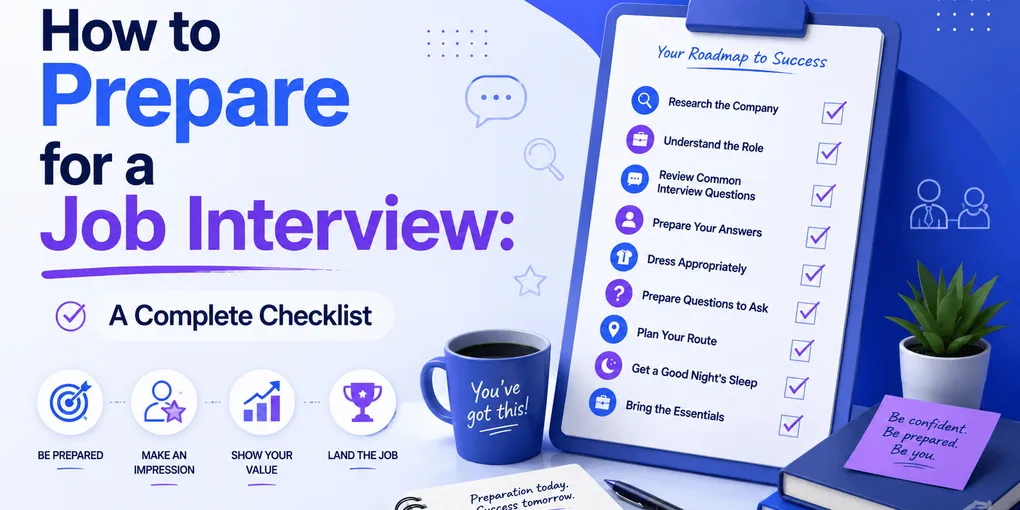
How to Prepare for a Job Interview: A Complete Checklist
Two candidates apply for the same job with nearly identical resumes. One walks in, gets asked “So, tell me about yourself,” and freezes into a rambling autobiography. The other opens with a 30-second pitch that maps straight onto the role, then backs every claim with a specific story. Same qualifications, wildly different outcomes — and the only variable was preparation. Interviews don’t reward the most experienced person in the room; they reward the person who did the most homework before walking in.
This guide shows you exactly how to prepare for a job interview, step by step: how to reverse-engineer the questions you’ll be asked, how to build answers that stick, what to research, what to ask, and how to handle the logistics so nothing derails you on the day. Work through it in order and you’ll walk in calm because you’ll already know roughly what’s coming.
TL;DR — how to prepare for a job interview:
- Re-read the job posting and list its top 5 requirements — those are your predicted questions.
- Build 3–5 STAR stories (Situation, Task, Action, Result) that prove those requirements.
- Rehearse “Tell me about yourself” out loud until it’s a tight 60–90 seconds.
- Research the company and your interviewer, and prepare 2–3 questions to ask them.
- Sort logistics the night before — outfit, route, printed resumes, tech test. Want your resume tight before you practice? Build or refine it free in CV-Mate.
Start With the Job Posting, Not Yourself
Most people prepare by rereading their own resume. That’s backwards. The interview isn’t about everything you’ve done — it’s about the slice of what you’ve done that matches this specific role. The job posting is a cheat sheet the employer literally handed you, listing the exact things they’ll probe.
❌ Vague prep: “I’ll just talk about my experience and see what they ask.” You end up over-explaining irrelevant projects and underselling the one that matters.
✅ Targeted prep: Copy the posting into a doc and highlight the top five requirements — the skills, tools, and responsibilities it repeats or lists first. Each one is a near-certain question. A posting that stresses “cross-functional collaboration” and “managing competing deadlines” is telling you it will ask, “Tell me about a time you handled conflicting priorities.”
This is the same instinct that makes a resume land — matching your material to the employer’s language. If you haven’t tailored your resume to this posting yet, do that first using our guide to finding and using resume keywords; the terms you pull for the resume are the exact themes your answers should hit.
Action step: Write out your five predicted questions from the posting. You’ll prepare a story for each in the next step.
Build STAR Stories You Can Reuse
Behavioral questions — “Tell me about a time you…” — are the backbone of modern interviews, and they’re the part candidates fumble most, because a good answer needs structure under pressure. The fix is the STAR method: Situation, Task, Action, Result. As LinkedIn’s own hiring resource notes, structured stories let a candidate “show” rather than “tell” how they’d behave in the role.
❌ Rambling answer: “I’m good under pressure. Like, there was this project and it was really stressful but we got it done and everyone was happy.” No specifics, no result, forgettable.
✅ STAR answer: (Situation) “Our launch date got pulled forward by two weeks. (Task) I owned the landing page and three email flows. (Action) I cut scope to the two highest-impact emails, pulled in a designer for two focused sessions, and set a daily 10-minute check-in. (Result) We shipped on the new date and the campaign drove a 22% open rate, above our 15% benchmark.”
Notice the good version ends on a number. Quantify the result whenever you can — it’s what makes the story land and stay memorable. Prepare four or five of these covering a spread of themes: a conflict, a failure you recovered from, a leadership moment, and a measurable win. Many double as evidence of the soft skills interviewers weigh heavily, so it helps to know which of your stories prove teamwork versus which prove technical judgment — our breakdown of hard skills vs soft skills helps you tag them so you can pick the right story for each question on the spot.
Here’s how question types map to what you prepare:
| Question type | Example prompt | What to prepare |
|---|---|---|
| Behavioral | ”Tell me about a time you failed.” | A STAR story ending in what you learned |
| Motivational | ”Why do you want this role?” | Company + role research tied to your goals |
| Competency | ”How do you prioritize under pressure?” | A concrete method + a STAR example |
| Situational | ”What would you do if a client escalated?” | Your approach, framed around their values |
| Self-assessment | ”What’s your biggest weakness?” | A real one + the steps you’re taking to fix it |
Action step: Write out five STAR stories in full sentences once. After that, rehearse them from bullet points so they sound natural, not memorized.
Nail “Tell Me About Yourself”
It’s the most common opener and the one people waste. It isn’t an invitation to narrate your life — it’s a 60-to-90-second pitch that frames how the interviewer sees everything after it. Get it right and you set the agenda; get it wrong and you spend the rest of the interview digging out.
❌ “Well, I was born in Chicago, studied biology because my parents wanted me to, then kind of fell into marketing, and, um, now here I am.” Chronological, aimless, gives the interviewer nothing to grab.
✅ Use a present → past → future arc: “I’m a content marketer with four years focused on B2B SaaS. Most recently I grew a company blog from 5,000 to 40,000 monthly visitors by rebuilding it around search intent. I’m looking to bring that same organic-growth playbook to a product like yours, which is exactly why this role caught my eye.”
That structure works because it opens with your current professional identity, offers one proof point, and lands on why this job. It’s essentially a spoken version of a resume summary — so if you’ve already written a strong one, adapt it. Our resume summary examples and formula give you a ready-made spine you can say out loud.
Action step: Draft your answer, then say it aloud and time it. If it runs past 90 seconds, cut the backstory, not the proof point.
Research the Company and the People
Interviewers can tell within minutes whether you’ve done any homework, and it colors everything. Research does double duty: it powers your “why this company” answer and it surfaces intelligent questions to ask later. The U.S. Bureau of Labor Statistics’ own careers guidance urges candidates to learn about the organization before interviewing so they can speak to how they’d fit.
❌ Surface skim: memorizing the company’s tagline and nothing else. It collapses the moment they ask, “What do you know about us?”
✅ Layered research: Spend 30–40 minutes across four things — the company’s product or service (try it if you can), their recent news or announcements, their “About/Mission” page, and the LinkedIn profiles of the people interviewing you. Knowing an interviewer spent five years in the field they’re hiring for lets you ask a question they’ll actually enjoy answering.
That last layer cuts both ways: your interviewers will almost certainly look you up too, so make sure your own profile is sharp before the call. Our guide to optimizing your LinkedIn profile covers the headline, About section, and photo that a hiring manager sees when they search your name the night before.
Action step: Write three specific facts about the company and one detail about each interviewer into your prep notes. You’ll weave them into answers and questions.
Prepare Questions That Make You Look Sharp
“Do you have any questions for us?” is not the end of the interview — it’s part of it. Answering “No, I think you covered everything” reads as low interest. Good questions signal that you’re evaluating the role as seriously as they’re evaluating you.
❌ Weak or self-serving: “What does the company do?” (you should already know) or “How much vacation do I get?” (save it for the offer stage).
✅ Sharp questions that show you’re thinking about the work:
- “What does success look like in this role in the first 90 days?”
- “What’s the biggest challenge the team is facing right now?”
- “How did this position become open?”
- “What’s something that’s changed here since you joined?”
Keep four ready, because one or two will get answered during the conversation. Tie at least one to your earlier research — “I saw you just launched X; how does this role support that?” — to prove you did the work.
Action step: Prepare four questions, at least one drawn from your company research, and write them on the notepad you’ll bring.
Sort the Logistics: Night Before and Day Of
The best answers in the world don’t help if you arrive flustered, late, or fumbling with a broken video link. Logistics are the easiest points to lock down and the most avoidable way to lose them. Interviewers read frazzled arrivals as a preview of how you handle real work.
❌ Sorting your outfit, route, and files the morning of — then discovering your only clean shirt needs ironing and the office moved buildings.
✅ Handle everything the night before, using this checklist:
- Outfit chosen, clean, and pressed — one notch above the company’s daily dress code
- Route planned with a time buffer, or video link tested on the actual platform
- 3–5 printed resume copies, notepad, pen, ID, and any work samples in one bag
- Interviewer names, address/link, and a contact number saved to your phone
- STAR stories and “tell me about yourself” rehearsed out loud one last time
- Phone charged and set to silent; alarm set with time to spare
- Two prepared questions reviewed
- A good night’s sleep — cramming past midnight hurts more than it helps
And know your own resume cold: interviewers pull questions straight from it, so you should be able to expand on any bullet without hesitation. If yours is overdue for a cleanup, our step-by-step guide to writing a resume will get it interview-ready before you print those copies.
Action step: Run this checklist the evening before every interview — treat it as non-negotiable, like a pilot’s pre-flight list.
FAQ
How do I prepare for an interview in one day?
Cover the highest-leverage items first: re-read the job posting and list its top five requirements, prepare three to four STAR stories that prove them, and rehearse “Tell me about yourself” out loud twice. Then spend 20 minutes on the company’s About page and recent news, jot down two questions, and lay out your outfit and documents. You can’t do everything in a day, so lock in the role match and your stories.
What should I bring to a job interview?
Three to five printed resume copies, a notepad and pen, your list of questions, a photo ID, and any portfolio or work samples your field expects. Save the interviewer’s name, the address or video link, and a contact number to your phone. Even for a virtual interview, keep a printed resume beside you for reference.
How early should I arrive for an interview?
Arrive at the building 10 to 15 minutes early — no more. Turning up 30 minutes early pressures the interviewer and looks like poor planning. If you’re there sooner, wait nearby and walk in at the 10-minute mark. For video, join two to three minutes early after testing your setup in advance.
How do I answer “Why should we hire you?”
Name the two or three things the role cares about most and match each to specific proof from your background. Keep it to about 30 seconds: state the fit, give one quantified result, and close with why you want this particular role. Skip generic labels like “hard worker” — point to something verifiable from your resume or a story you’ve told.
What are the steps of the STAR method?
STAR stands for Situation, Task, Action, and Result. Set the scene in a sentence, state what you were responsible for, spend most of the answer on the specific actions you took, and end on a measurable outcome. It keeps behavioral answers structured and concrete instead of rambling.
How do I prepare for a virtual interview?
Test your camera, microphone, and internet on the actual platform a day ahead and again 10 minutes before. Sit somewhere quiet and well-lit with a plain background, keep notes just off-camera, and raise the camera to eye level. Look at the lens when you speak, silence notifications, and have a phone number ready in case the call drops.
Preparation Turns Nerves Into Confidence
Interview anxiety mostly comes from uncertainty — not knowing what they’ll ask or how you’ll respond. Every step in this guide removes a piece of that uncertainty, so by the time you walk in, the interview feels less like an interrogation and more like a conversation you’ve already half-rehearsed. Do the homework and confidence stops being something you fake; it becomes something you’ve earned.
If your resume isn’t pulling its weight yet, that’s the place to start — it’s what generates half the questions you’ll be asked. You can build a clean, tailored resume free in CV-Mate, or browse our resume examples to see how a strong one is structured before you walk into the room.
Ready to build your resume?
You've got the knowledge. Now put it into action—create a professional resume in under 10 minutes with our builder.
No credit card required · Export as PDF · ATS-friendly templates