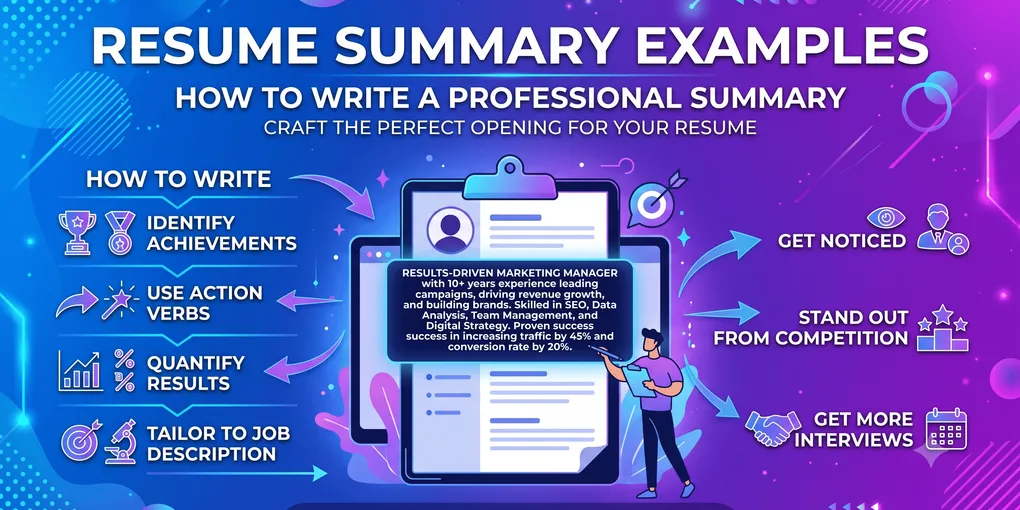
Resume Summary Examples: How to Write a Professional Summary
Recruiters spend an average of about 7 seconds scanning a resume before deciding to keep reading or move on. Almost all of those seconds land at the top of the page — which is exactly where your resume summary sits. Get it right and you buy yourself a full read. Get it wrong, or skip it, and the rest of your hard work may never be seen.
A professional summary is the 2–4 sentence pitch that opens your resume. It states who you are, what you do well, and the proof that you do it. Done well, it works like a movie trailer: enough to make the recruiter want the whole story. This guide gives you a repeatable formula plus 12 resume summary examples across career stages and roles — entry-level, mid-career, manager, and career changer — so you can adapt one to your own situation today.
What Is a Resume Summary (and When to Use One)
A resume summary is a short paragraph at the very top of your resume, directly under your name and contact details. It compresses your strongest selling points — job title, years of experience, signature skills, and one quantified win — into something a recruiter absorbs in a glance.
Use a summary when you have relevant experience to point to, even a few internships or projects. It is the default choice for most candidates. The alternative, a resume objective, states what you want from the role rather than what you offer, and it now reads as dated for anyone past entry level.
The summary is not a place for “hardworking team player.” It is a place for evidence. Every line should answer the recruiter’s silent question: why should I keep reading? If you are still building the resume underneath it, start with our step-by-step guide to writing a resume from scratch and come back to polish the summary last — it is easier to summarize a resume that already exists.
Action step: Decide now — summary or objective. If you have any relevant experience, choose summary.
The 3-Sentence Resume Summary Formula
You do not need to be a writer. You need a structure. This formula works for almost any role:
- Sentence 1 — Identity: Your professional title + years of experience + specialty.
- Sentence 2 — Proof: One or two quantified achievements that match the job.
- Sentence 3 — Value: The skills or focus you bring to this employer.
Here it is filled in:
“Customer success manager with 6 years of experience in B2B SaaS. Cut churn by 22% and grew net revenue retention to 118% across a 200-account portfolio. Skilled in onboarding design, QBR strategy, and cross-functional advocacy for enterprise clients.”
Notice three things: a real title, hard numbers, and language pulled straight from the kind of job posting this person is targeting. That last point matters for software too — applicant tracking systems scan your summary for role-specific terms, so the keywords you choose here carry weight. Learn how to source them in our guide to finding and using resume keywords.
Action step: Draft your three sentences now, even rough. You will tighten them in the next steps.
Resume Summary Examples by Career Stage
The formula bends to fit where you are in your career. Here are four worked examples.
Entry-level (recent graduate):
“Marketing graduate with internship experience at a 50-person agency, where I ran social campaigns that grew client engagement 35% over three months. Strong in content creation, Google Analytics, and A/B testing. Eager to bring data-driven storytelling to a junior marketing role.”
Mid-career professional:
“Full-stack developer with 5 years building React and Node.js applications for fintech. Shipped a payments dashboard used by 40,000 monthly users and reduced API response time by 60%. Focused on clean architecture, testing, and mentoring junior engineers.”
Manager / leader:
“Operations manager with 9 years leading teams of 15+ in high-volume logistics. Redesigned a fulfillment workflow that lifted on-time delivery from 82% to 97% and saved $400K annually. Known for calm execution under pressure and building processes that scale.”
Career changer:
“Former high school teacher transitioning into UX design, with a completed Google UX certificate and three end-to-end portfolio projects. Combines 7 years of explaining complex ideas simply with user research and Figma prototyping. Driven to design accessible, human-centered products.”
Each one names a title, leads with proof, and signals direction. None of them say “responsible for.”
Action step: Pick the example closest to your stage and rewrite it with your own facts.
Resume Summary Examples by Role
Tailoring to your function sharpens the pitch further. A few role-specific samples:
Sales:
“Account executive with 4 years closing mid-market deals. Hit 130% of quota two years running and grew average deal size by 28%. Expert in consultative selling, pipeline forecasting, and multi-stakeholder negotiation.”
Project Manager:
“PMP-certified project manager with 8 years delivering software and infrastructure projects up to $2M. Delivered 95% of projects on time and on budget across cross-functional teams of 12. Fluent in Agile, stakeholder management, and risk planning.”
Registered Nurse:
“Compassionate RN with 6 years in acute care and a 98% patient satisfaction score. Managed 5–6 patient loads in a 30-bed unit and trained 12 new hires on EHR protocols. Skilled in triage, IV therapy, and interdisciplinary coordination.”
Administrative Assistant:
“Executive assistant with 7 years supporting C-suite leaders at a Fortune 500 firm. Managed complex calendars across 4 time zones and cut travel-booking costs 18%. Detail-obsessed, discreet, and proactive under shifting priorities.”
For even more samples you can clone and edit, browse the CV-Mate resume examples library, which sorts ready-made resumes by role and industry.
Action step: Find your role above or in the examples library, and steal the sentence structure — not the facts.
Common Resume Summary Mistakes to Avoid
A summary fails in predictable ways. Avoid these:
- No numbers. “Improved sales” means nothing. “Grew sales 24%” means everything. Quantify or cut.
- Buzzword soup. “Results-oriented, dynamic, passionate self-starter” tells a recruiter nothing about what you actually did.
- Writing in the first person with “I”. Skip pronouns. Start with the punchy noun or verb: “Operations manager with…” not “I am an operations manager who…”
- One summary for every job. A generic summary signals low effort and misses the keywords each posting wants.
- Too long. Past four sentences, it stops being a summary and starts competing with your experience section.
These overlap with the broader patterns that get applications rejected — see our breakdown of the most common resume mistakes and how to fix them to pressure-test the rest of your document, and check that your formatting survives software screening with our guide to writing a resume that passes ATS.
Action step: Read your draft aloud. Cut any word you would not say in a real conversation.
How to Tailor Your Summary to Each Job
The single highest-leverage move is matching your summary to the posting in front of you. It takes two minutes and it works.
- Copy the job title exactly. If they hire a “Growth Marketing Manager,” do not call yourself a “Marketing Lead” in your summary.
- Pull two or three must-have requirements from the posting and make sure your summary reflects them — by skill, tool, or outcome.
- Match one achievement to their biggest pain point. If the role is about scaling, lead with a scaling number.
This is not lying; it is prioritizing. You are choosing which true facts about you to surface first based on what this employer values most. The same resume, reframed, can read as a perfect fit for two different jobs.
Action step: Keep your “master” summary saved, then spin a tailored version for each application in under two minutes.
Frequently Asked Questions
What is a resume summary? A resume summary is a 2–4 sentence paragraph at the top of your resume that states your job title, years of experience, top skills, and one measurable achievement. It tells the recruiter who you are and why you fit before they read the rest of the page.
How long should a resume summary be? Keep it to 2–4 sentences, roughly 40–60 words. Longer and it competes with your experience section for attention and gets skipped. If you cannot say it in four sentences, push the detail down into your work-history bullets.
What is the difference between a resume summary and an objective? A summary describes what you have already achieved and what you offer. An objective describes what you want from the job. Summaries suit candidates with experience; objectives are mostly for career changers or entry-level applicants leading with goals and transferable skills.
Should I write a resume summary if I have no experience? Yes. Lead with your degree, certifications, relevant coursework, internships, or projects, and name the transferable skills the job needs. Frame it around the value you bring, not the experience you lack, and quantify anything you can.
Do I need to tailor my resume summary to each job? Yes. Mirror the job title and two or three key requirements from each posting. A generic summary reads as filler; a tailored one matches the recruiter’s checklist and the keywords an ATS scans for.
Conclusion: Write the Summary Last, Read It First
Your resume summary is the seven seconds that decide whether the rest of your resume gets read. The winning formula is simple: state your title and experience, prove it with a number, and point that proof at the job in front of you. Skip the buzzwords, skip the pronouns, and tailor it every time.
You do not have to start from a blank page. Build your resume with CV-Mate’s free resume builder — it structures your summary, suggests role-specific phrasing, and keeps your formatting ATS-safe from the first draft. Pick a resume example close to your role, adapt the summary, and you will have a recruiter-ready opener in minutes.
Ready to build your resume?
You've got the knowledge. Now put it into action—create a professional resume in under 10 minutes with our builder.
No credit card required · Export as PDF · ATS-friendly templates